Friday, June 10, 2016

Fakarava South and Toau


After enjoying the underwater marvels of the South Pass we headed north within the Fakarava atoll as our supplies were dwindling.  We reached a little "Pension" called Pakokota, that was not in the guide books, found by good fortune.   Matthieu and Agnes run a small yacht services business too and they helped us out greatly.  For very reasonable prices they helped us acquire eggs, gas, laundry and groceries.  


We were so happy to have some fresh food!


We enjoyed a lovely meal Agnes and Matthieu made for us in thier open air kitchen dining area.


We went to Toau, an atoll just north of Fakarava.  We had an exciting time going through the pass which was reported to be dangerous,  We actually took a run at exiting the pass while the tide was still outgoing a couple of knots, which pushed the boundaries as we sailed through some breakers.  Next time, on a pass like this, we will probably wait for a completely slack tide, although Merry Dolphin proved herself by handling surfing very well.

Back in Fakarava we got to do some biking!


Coconuts are free, smiles are abundant, clean clear blue water everywhere.  Chicken is very reasonable.... but produce not so abundant, one pepper, one carrot and one grapefruit was almost $10 Canadian dollars.

Carrie and Sophie with Merry Dolphin anchored behind


Again tonight we had a great opportunity to see some great Polynesian culture: a show at the school with local dancers and some amazing kids who came from the Marquesas. 


Head bird

These woman could shake!


 This girl was calling out!

A local cutie.


After enjoying Fakarava and the Tuamotus we are excited to head to Tahiti  were Carrie, Sophie and Robert will hop a commuter flight to Bora Bora, crossing off a long standing item from Carrie's bucket list while Dave and the boys do a sailing rally (i.e. Regatta) and some surfing.

The adventure continues!


Thursday, June 2, 2016

Leaving the Marquesas for the Dangerous Archipelago

 Reluctantly we left the beautiful Marquesas May 21 st as a favorable weather window appeared for a nice sail to the Tuamotus (theoretically).  If we missed this weather it would be at least 10 days until we might be able to leave.  Although the Marquesas are fantastic, we have a lot of things we want to see and do ahead in the Tuamotus and Society Islands.
After getting out of the lee of Ua Poa, day one of the crossing lived up to stories and descriptions of ideal trade wind sailing in the south pacific.  The breeze was and an incredibly steady 12-14 knots from the east with comfortable seas allowing us to smoothly glide along toward our destination with good speed.   To top it all off we saw a beautiful pod of dolphins.

Day 2 started out much the same as day 1, but by as the day progressed the skies clouded over.   Night brought heavy rain which did not let up until morning.  This rain was colder than the rain at the equator and Carrie and I donned our foul weather gear.  Even with the rain gear we were immediately soaked right to the skin and we did not sleep at all.


Day3 was wonderful again, allowing us to forget the night before!  As we neared Kauehi, our destination atoll, the weather turned sour again.  It was the wee hours of the morning and the crew was catching some much needed rest and Dave was on deck furling the jib and dropping the main as the wind died.  Then we were slammed by a full on squall.  The water went completely white.  The rain was blowing horizontally and there was so much wind and water it was difficult to breathe.     Dave hopped up to release the mizzen sail but it was so dark and rainy that seeing the lines was next to impossible.  Luckily Sophie appeared offering her help and she shone the flash light allowing Dave to release the sail.  We were safe and we survived a nasty White squall.
In the morning things were grey and cloudy as we neared the pass into the atoll and again a massive pod of dolphins came to greet us.  These lovely creatures made us all forget the bumps of the night before.
In order to enter an atoll requires going through a pass.  Passes are usually only safe at slack tide.   The entire water of the tide has to squeeze through the often very tight passes.

After safely navigating the pass we radioed our friends on “Day Break” to let them know that the pass was safe for entry and they entered behind us.  The skies were still grey but as we followed the channel towards the village anchorage, the sun started to burn away the clouds and by the time we arrived at the anchorage the spectacular view of our first south pacific atoll lay before us.  We had survived the passage and our first pass in “Dangerous Archipelago” (i.e. Tuamotus).


Pristine beauty of our first atoll


Yael wind surfing in the Kauehi atoll.


From the beautiful anchorage we were able to go into the village.   A mere 150 people live on the atoll called Kauehi.   We walked through the very simple village.  We met the self-proclaimed ‘mayor’ named “Adram” who farms black pearls.    He invited us to his home where he and his wife welcomed us with exceptional generosity of spirit.  They showed us black pearls and Dave picked out the finest for a necklace for Carrie as a birthday gift.   Adram’s wife offered Carrie a ring she made with her own hands as a birthday gift.  She then drove us around the atoll on a tour to her cousin’s property at the far end of the atoll.  It is an old pearl farm and they have thousands of old mooring balls which they have piled up against the bases of coconut trees to make “jolie”.   It was an exceptional day for all of us and particularly for Carrie on her 35th birthday. 


We spent 3 days in all at this atoll and with some degree of sadness about leaving,  made ready for passage to our next stop in paradise “Fakarava” 30 miles south.    It is extremely important to plan for entry through passes and atolls.  There are currents,  tides and light to consider.  Once through the pass the atolls are also very tricky to navigate as there are coral heads like ‘mine fields’ waiting beneath the surface.  We had a couple of close calls in the Kauehi  lagoon.
Fakarava


We sailed an uneventful overnight  passage to Fakarava in order to arrive at slack tide in daylight at Tumakohua pass.  This is a world class diving location.  At the side of the pass there is an old Polynesian village complete with grass huts where guests can  stay.    It is a deep pass with steep coral side walls.  Multiple species of sharks make this pass their home.   We swam in little lagoons in the village in the company of needle fish,  “Napoleon fish”, “meroux” and black tipped sharks.  


Friday, May 20, 2016

Repairs, Horses, Steve and Ua Poa

Repairs, Horses, Steve and Ua Poa

We have been enjoying Hiva Oa.  The local people are all so generous and kind.  Marquesans  have given us so much fruit, offered us rides and happily shared their beach and waves for surfing.


On our last day we met a local carver who made us a special Dolphin carving with traditional writing embossed into it for protection and symbols of the sea and our passage.  He also agreed to let Sophie go horse riding after we collected his half wild horses from the woods.

Seth got in on the fun.


Before heading to our next island Ua Poa, the kids wanted to see Steve again (our Robinson Caruso friend on the deserted beach) and introduce Robert to him.  Sophie made him another chocolate cake while Steve taught us to properly open coconuts, find shells and finally to teach Yael how to spear fish.


Now we are exploring Ua Poa which is a beautiful Island with lots of Marquesan culture.  We are considering leaving tomorrow for a three day crossing to the Tuamotus as the winds look favorable.


Many dolphins lead us into Ua Poa

And Carrie studying the map and guides


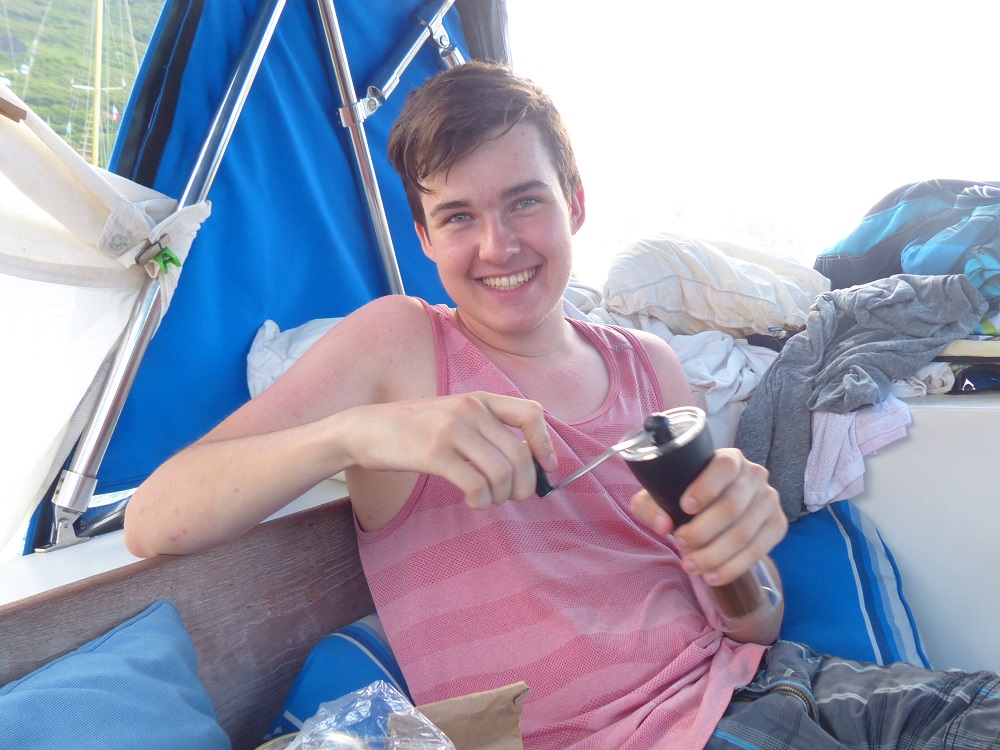
 Here is Robert grinding coffee for the passage


Update : it looks like we will leave Ua Poa for the Tuamotus heading South West for 450 miles this afternoon, our last big crossing.  We met another boat with a family we will "race" as we cross.


Sunday, May 15, 2016

Tahuata and Puamo

Tahuata and Puamo

After checking in at Hiva Oa we made a small hop to another Island called Tahuata.  This small, sparsely populated island has beautiful white sandy beaches.  We went to an anchorage called Hanamoeoa which we nicknamed  ‘Steve’s beach.
                                    

We enjoyed snorkelling in the clear water and seeing the fish.  Some were bright blue and some were almost translucent.  There was also a ferocious puffer fish hanging out under the boat.


                              A very nice guy named Steve lives on this beach and is a Marquesan Robinson Caruso.  We brought him chocolate and some other treats.  He took Seth snorkeling, shared coconuts and made us Marquesan espresso.  

Later Steve caught a wild pig and cooked up a feast for us and his American friends from another boat anchored in the bay.  It was a once in a lifetime experience.  The food was cooked to delicious perfection on Steve’s open fire. 

Robert joins the Crew


We went back to Hiva Oa to meet Robert.  Unfortunately the day we needed to sail back gave us a brutal 30 knot wind.  We spent five hours beating into the wind with a double reef.  Merry Dolphin did quite well considering and eventually we clawed our way east of the rocky headland to make our way back into the Atuona Bay.


After a day of rest we rented a car and drove over the Island from Atuona  to a small village that is home to an ancient site with “Tikis”.  Tikis are the Polynesian equivalent of totem poles.  The road over was brutal.  We had a 4 wheel drive Toyota but it was still a push.  The road was worse than the most dangerous BC logging road but the payoff was huge.


After climbing down the mountain to the coast we stopped and body surfed this beautiful beach with soft silver sand.

Tikis


The site in a little town called Puamau  has a well preserved sanctuary where the tikis are located.  The site is an ancient place of great religious significance,


Saturday, May 7, 2016

Crossing and Landfall

We arrived at Atuona Bay, Hiva Oa in the Marquesas, May 4th, 2016, just shy of 25 days after our departure from Half Moon Bay, near San Francisco.  The three Children, Carrie and I braved the Pacific Ocean, together.

The boat performed amazingly well.  Except for a failed fresh water pump on the engine, nothing significant went wrong with the boat or equipment.    With respect to the engine problem, you know our philosophy: “It’s a sailboat; we don’t “need” an engine.” 

We knew the Pacific was bigger than the area of land on the entire planet but still the enormity of the Pacific was surprising.  Day after day we endlessly covered areas of vast open ocean and a constant 360 degree horizon.  We saw almost no traces  humans as we were crossing, except a very occasional bit of garbage seen far off the coasts of Mexico and Central America and Mexico and one fishing vessel with which we crossed paths within one nautical mile near the equator.


Blue Water Sailing


Once we were a few days into the voyage, the ocean turned an unbelievable beautiful blue that is only seen offshore. 


Animals


We saw whales and dolphins.  The first exciting encounter was when Sophie said, “I think I see a Shark” and about a minute later an Orca whale swam within a meter of the boat, RIGHT NEXT to where I was sitting, I let out a very startled yell.

Another fantastic encounter was about 300 miles away from the Marquesas when a pod of dolphins spent an hour playing in our bow wave, really cool.

We saw a number of big whales too, nothing so close as the Orca but all exciting none-the-less.


Temperature extremes


The first week was nice and warm when the sun was up and quite cold at night.  As we got as far south in latitude as mid-Mexico it got warmer at nights.  This all changed quite dramatically as we got closer to the equator and it got much warmer.  The water temperature rose significantly going from 12 degrees  C in San Francisco to almost 30 degree C water at the equator.

By the time we were just south of the equator it was almost unbearably hot and humid in the boat, even at night.


ITCZ
There is an area near the equator (just north of the equator this time of the year) where there is sometimes light (or no) wind (also known as the Doldrums) mixed with occasional squalls.  We were lucky in this area as we had decent wind throughout.  We did encounter a few squalls but we managed to ride them out. 
On one occasion we went through a rain storm like nothing any of us have has ever seen.   The quantity of rain was unbelievable.  We managed to all get showered and wash clothes!


Flying fish
We saw a lot of flying fish which are amazing creatures.  The bigger ones fly over 50m just over the tops of the waves.  There are also big schools of smaller flying fish.   Some of the unfortunate ones would land on the deck at night.


Homework and reading

We all read a lot.  The kids did homework most days, except when we had rough seas that knocked our energy down too much.  We really enjoyed using the experience as a basis for some of our homework including geography, oceanography, astronomy and navigation.


The Equator
After 19 days, we crossed the equator.  This was a time to celebrate.  Sophie made cupcakes! 


Landfall in Paradise

Hiva Oa has not disappointed!  The landscape here is more beautiful than we could have imagined with lush vegetation adorning dramatic mountains shooting out of the sea.   We are surrounded by relaxed Marquesan Polynesian people and culture.   There is almost no English spoken here, it is entirely French, with some native language heard from the Polynesian rowers.   The anchorage of cruisers has a lot of French nationals.  There are a few US flagged boats, and we have the only Canadian flag that I can see.